外观
本页尚未翻译
本页内容仍为英文原文,源自官方文档 enterprise/index。中文翻译正在分批进行中。
LanceDB Enterprise
Features and benefits of LanceDB Enterprise.
LanceDB Enterprise is the production deployment option for teams that want to run LanceDB as a private cloud or bring-your-own-cloud (BYOC) multimodal lakehouse.
If you are new to multimodal lakehouses, the short version is this: LanceDB keeps vectors, metadata, and source data together in open table storage, while Enterprise adds the distributed infrastructure needed to serve real production workloads on top of that data. It is designed for teams that need more scale, more operational visibility, and more control than a single embedded process can provide. LanceDB Enterprise distributes query execution, indexing, maintenance and refresh work across the service, outside your application.
If you need private deployments, high performance at extreme scale, or if you have strict security requirements, reach out to our team to set up a LanceDB Enterprise cluster in your environment.
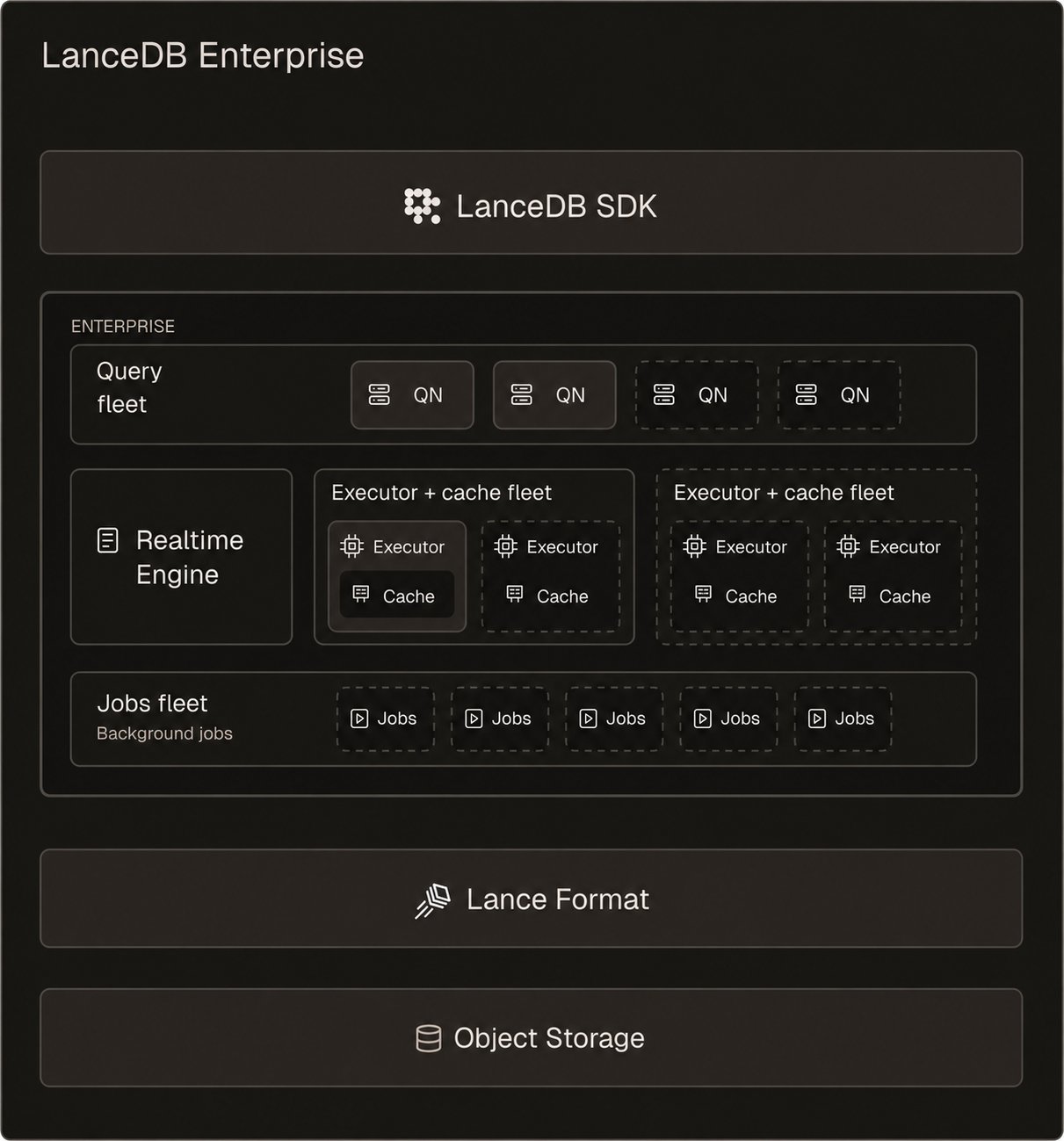
LanceDB Enterprise: the LanceDB SDK connects to the Enterprise service, where a query fleet, executor and cache fleets, the realtime engine, and a jobs fleet run on top of the Lance format and object storage.
Why use LanceDB Enterprise?
If you are evaluating LanceDB for a production AI system, Enterprise is built around three practical needs: handling very large vector workloads, running feature engineering close to the data, and operating the platform with production visibility.
1. Scale shared workloads
LanceDB Enterprise is built for demanding workloads that exceed the capabilities of a single machine, whether from extremely large data volumes or a high number of concurrent queries. Instead of asking your application to own caching, query scaling, and maintenance, Enterprise turns those into platform capabilities.
This matters when your AI application moves past a prototype and starts serving real users, larger datasets, and more concurrent requests.
- Low-latency tiered cache: Enterprise keeps frequently read data closer to compute, so common queries do not need to fetch the same data from object storage over and over again. That helps reduce wait times and makes performance more predictable as traffic increases.
- Horizontal query throughput: Instead of relying on one application process to answer every query, Enterprise can spread search traffic across multiple nodes. This lets teams add capacity as usage grows, rather than re-architecting the application each time demand spikes.
- Background maintenance: Enterprise builds indexes and compacts tables on background workers, reducing the maintenance work your application needs to schedule.
2. Feature engineering
For many teams, retrieval is only part of the problem. They also need a reliable way to derive new columns, run backfills, and keep feature pipelines close to the data they already store in LanceDB. This is what feature engineering enables.
- Derived features: Create new columns from existing data and user-defined logic without standing up a separate feature platform first.
- Large-table backfills: Update or recompute features across large datasets without wiring your own distributed batch system around LanceDB Embedded tables.
- Shared workflows: Manage feature engineering work -- clusters, jobs, and their configuration -- in one place.
3. Enterprise-grade monitoring
Production retrieval systems need more than search or training performance. Teams also need to observe the system, choose how it is deployed, and satisfy security and compliance requirements.
- Metrics and traces: Integrates with existing observability systems for monitoring and distributed tracing using OpenTelemetry.
- Deployment choice: Run LanceDB as a managed deployment or install it inside your own cloud account with BYOC.
- Private networking and compliance: Designed for production environments that need encryption at rest, private connectivity options, and compliance coverage such as SOC 2 Type II and HIPAA.
Deployment and governance
LanceDB Embedded is included as part of your binary, Docker, or serverless function. The footprint is small, and no extra services run beside it.
LanceDB Enterprise comes in three deployment models, all supporting AWS, GCP, and Azure:
Managed is a private deployment of LanceDB Enterprise: applications run in cloud accounts managed by LanceDB, in the same location as your client applications. This hands-off approach suits teams that do not want to manage the infrastructure themselves. LanceDB can provision either a public or private load balancer for access.
Bring-your-own-cloud (BYOC) installs LanceDB Enterprise into your own cloud account, so data never leaves it. Reach for this when data-residency requirements preclude data from leaving your account, or when other applications need to access the object storage directly. An identity is provisioned in your account with permissions to manage the infrastructure.
Custom deployments cover requirements beyond the two models above -- reach out to our support team.
Both Managed and BYOC are designed for private networking, compliance, and operational oversight.
See how Enterprise compares to Embedded
Embedded vs EnterpriseA feature-by-feature comparison: architecture, latency, throughput, caching, maintenance, and day-to-day usage differences.Reach out to us to set up LanceDB Enterprise in your organization, or to arrange a proof of concept for your workload.